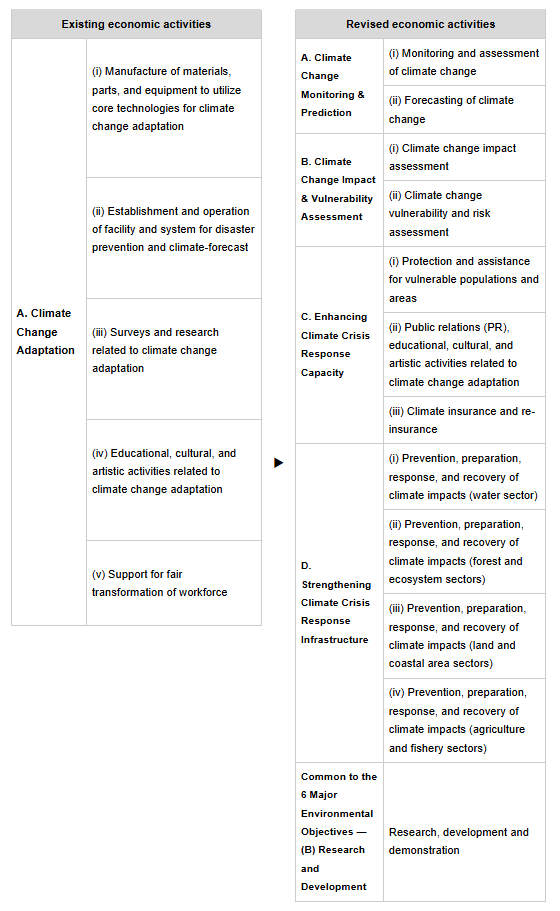
On December 31, 2025, the Ministry of Climate, Energy and Environment (“MCEE”) announced the revised Korean Green Taxonomy (“K‑Taxonomy”). This update marks the first regular triennial revision since the framework’s initial establishment in December 2021. These revisions and new additions reflect changes in laws, policies, and industries, as well as the current state of technological development regarding economic activities for two key environmental objectives—(i) greenhouse gas (“GHG”) reduction and (ii) climate change adaptation. The main revisions are as follows:
Key revisions to the K-Taxonomy
|
1. |
Economic Activities in Promotion of GHG Reduction |
|
(1) |
Industry |
-
Reflection of South Korea’s 100 Core Carbon Neutrality Technologies; specification of core GHG reduction technologies
|
– |
Aligned with South Korea’s 100 Core Carbon Neutrality Technologies, the revision upgrades recognition criteria for core GHG reduction technologies across 17 fields. |
-
Revision and establishment of economic activities based on the 4th National Allocation Plan (2026–2030)
|
– |
Recognition criteria for existing economic activities now reflect the product emissions-efficiency benchmark (“BM”) allocation coefficients from the 4th Planned Period of the Greenhouse Emission Trading Scheme (“ETS”). |
|
– |
Semiconductor and display manufacturing have been added as new economic activities, reflecting the expansion of BM allocations. |
|
(2) |
Power Generation/Energy |
-
Subdivision of economic activities by generation type; establishment of waste-to-energy as a new economic activity
|
– |
Previously consolidated economic activities are now categorized individually ((i) solar photovoltaics, (ii) concentrated solar power (“CSP”), (iii) wind power, (iv) hydropower, (v) ocean energy, (vi) geothermal energy, (vii) hydrothermal energy) by generation type to better reflect unique source characteristics. |
|
– |
With the inclusion of waste energy under the Enforcement Decree of the Act on the Promotion of the Development, Use, and Diffusion of New and Renewable Energy, the construction and operation of waste-to-energy and combined heat and power (“CHP”) facilities have been newly classified as eligible economic activities. |
-
Establishment of new economic activities for next generation low carbon technologies
|
– |
The construction and operation of facilities for Sustainable Aviation Fuel (“SAF”) production have been added under “Bioenergy Manufacturing Activities.” Additionally, a new category for “Clean Methanol Manufacturing” has been established, encompassing both green and blue methanol. |
|
– |
Furthermore, new categories have been created for the installation and operation of heat pumps that utilize low-carbon thermal sources, such as renewable energy (geothermal, hydrothermal, etc.) or aerothermal energy. |
|
(3) |
Transport |
-
Expansion of Pollution-free Transport and Infrastructure
|
– |
The scope has been expanded to include the manufacturing and adoption of pollution free motorized bicycles (including personal mobility devices). Additionally, activities related to the construction of carbon-reducing aviation infrastructure and the development of supply infrastructure for low-carbon fuels (e.g., bio-marine fuel and SAF) have been added. |
-
Transition of Recycling Exclusion Criteria to “Annual Recyclability Rates”
|
– |
To improve industry feasibility, the existing exclusion criteria for “end-of-life vehicle (“ELV”) recycling rates” has been replaced with the “Annual Recyclability Rate.” |
|
(4) |
City/Building |
-
Raising Green Building certification standards
|
– |
The recognition criteria for Zero-Energy / Green Buildings (1-C-(3)) and Low-Carbon Internet Data Center (“IDC”) Construction and Operation (1-C-(5)) have been strengthened. Specifically, the required G-SEED (Green Standard for Energy and Environmental Design) rating for public buildings has been raised from Level 4 to Level 3. |
|
– |
In addition to domestic certification, international standards (e.g., Leadership in Energy and Environmental Design) are now recognized as valid eligibility criteria. |
|
(5) |
Agriculture |
-
Inclusion of low carbon livestock to the definition of low-carbon agriculture and expansion of eligibility criteria
|
– |
To encompass low-carbon livestock products, the definition of “low carbon agriculture” has been revised to: “Activities that apply technologies or methods contributing to greenhouse gas (“GHG”) reduction during the processes of crop cultivation and livestock farming.” |
|
– |
Additionally, the scope of eligibility has been expanded. Low carbon agricultural and livestock activities now qualify if they have obtained a “Registration Approval for Voluntary GHG Reduction Projects in Agriculture and Rural Areas” or have been validated for External Project Feasibility under Article 13 of the Guidelines for Feasibility Assessment of External Projects and Certification of Reductions. |
|
(6) |
Carbon Dioxide Capture |
-
Reorganization of economic activities and establishment of new category for CO2 utilization
|
– |
To better reflect the operational flow of carbon management, economic activities have been reorganized into the following sequence: Carbon Capture → Transportation → Storage → Utilization. |
|
– |
A new category has been established for activities involving the development of technologies that utilize captured CO2, as well as the construction and operation of facilities required for the production of CO2-derived products. |
|
(7) |
Forestry |
-
Introduction of the forestry sector within GHG reduction goals
|
– |
To promote forestry activities as a means of carbon sequestration and mitigation, two new categories have been established: (i) the creation of forest based carbon sinks and (ii) the utilization of domestic timber products. |
Meanwhile, the South Korean government has announced plans to restructure the support framework for transitional economic activities—such as energy production based on LNG—that facilitate the shift toward carbon neutrality. This restructuring will follow inter-ministerial consultations and will coincide with broader institutional reforms, including the introduction of Transition Finance. Consequently, it is essential to closely monitor upcoming developments, particularly the Transition Finance Guidelines scheduled for release in 2026.
|
2. |
Economic Activities for the Objective of Climate Change Adaptation |
Implications
|
1. |
Preparedness for Financial institutions |
|
2. |
Preparedness for Climate Disclosure |