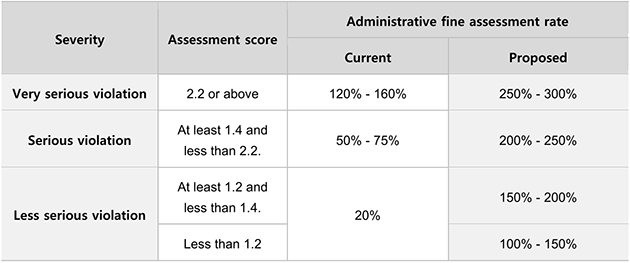
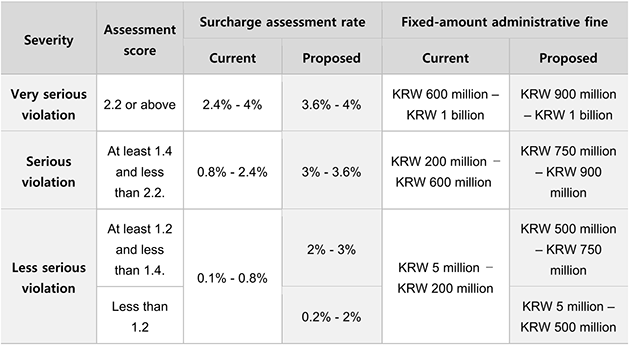
On March 9, 2026, the Korea Fair Trade Commission (“KFTC”) announced a draft amendment to the “Notification on Detailed Standards for the Imposition of Administrative Fines” (“Draft Amendment”), with the public consultation period scheduled from March 10, 2026 to March 30, 2026.
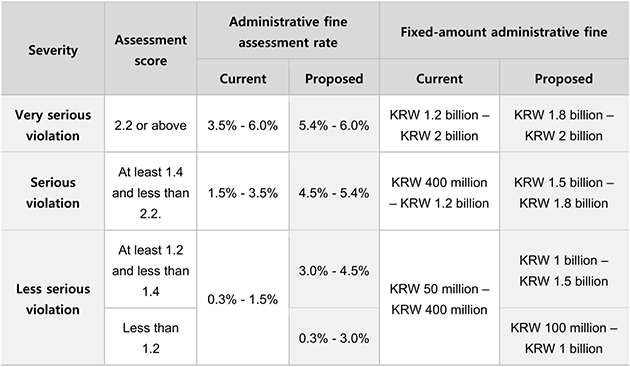
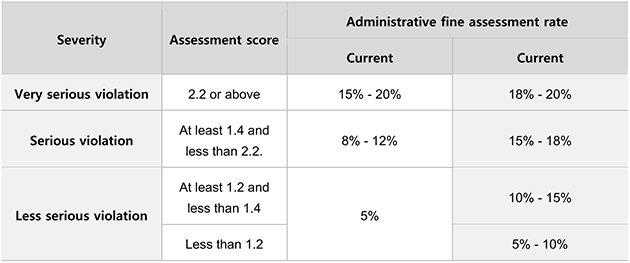
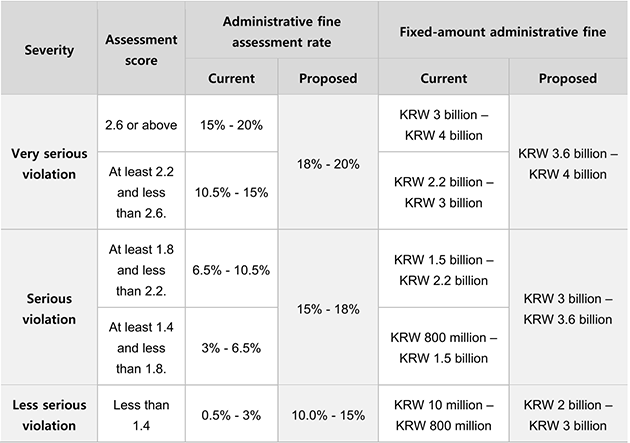
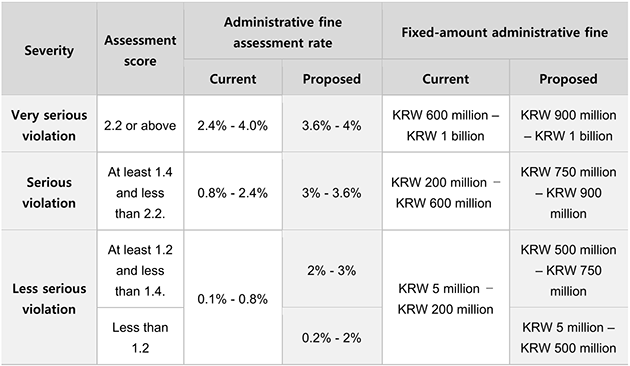
The Draft Amendment is to enable imposition of administrative fine at levels that exceed the unlawful gains obtained from violations of the law. Specifically, the Draft Amendment mainly proposes to: (i) raise the lower bound of the administrative fine assessment rates, (ii) strengthen the degree of administrative fine for repeat offenders, and (iii) eliminate or reduce the discretionary mitigation factors for administrative fine.
|
2.
|
Strengthening the Degree of Administrative Fine for Repeat Offenders
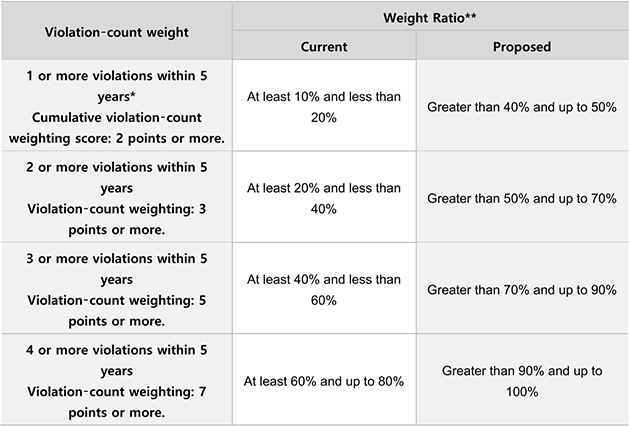
The Draft Amendment proposes to strengthen the fine multipliers so that even a single prior violation can result in an increase of up to 50%, and, depending on the number of violations, up to 100% (under the current rules, a single prior violation results in a 10% increase, which may increase by up to 80% depending on the number of violations and the combined weighting score). In particular, for collusion, the Draft Amendment will provide grounds to increase the administrative fine by up to 100% if the violating company had been fined for a collusive conduct at least once in the past ten years.
|
|
3.
|
Elimination and Reduction of Discretionary Mitigating Factors
The Draft Amendment proposes to reduce the scope of mitigation so that mitigation of up to a total of 10% may be applied for cooperation during the entire investigation and hearing stage (under the current rules, mitigation of 10% may be applied at each of the investigation and hearing stages, for a total of up to 20%). The mitigation rate for voluntary corrective measures would also be reduced from a maximum of 30% to 10%. Meanwhile, the provision allowing mitigation for “minor negligence” (10%) will be deleted.
Furthermore, the Draft Amendment proposes to establish grounds for the KFTC to rescind mitigation benefits that was granted to a business that cooperated with a KFTC investigation or hearing if that business subsequently appeals the KFTC’s decision to the court and, during litigation, denies the materials or statements it submitted during the investigation/hearing or if those submissions are found to be false.
|
|
4.
|
Implications
In announcing the Draft Amendment, the KFTC emphasized the need to impose administrative fines that effectively exceed the unlawful gains obtained from a violation of the law. This suggests that the KFTC does not simply intend to increase the imposition rate through this amendment, but that the actual amounts of administrative fines imposed in practice will likely increase.
Going forward, businesses should expect that violations of the FTL could result in administrative fines of a magnitude that is materially damaging to business. It is therefore increasingly important to strengthen compliance to prevent violations in advance, institutionalize a zero tolerance approach over breaches of internal controls, and proactively manage antitrust-related legal risks.
Separately, on December 29, 2025, the KFTC announced a plan to raise statutory caps on administrative fines for violations of the FTL and other laws under its jurisdiction, and stated that it will submit a bill to the National Assembly in the first half of 2026 (Link) for this purpose. If the statutory cap on administrative fines is raised, we may expect an overhaul of the administrative fine regime, including further amendments to the Notification on Detailed Standards for the Imposition of Administrative Fines which determines the detailed imposition rates.
|
[Korean Version]