On December 29, 2025, the Korea Fair Trade Commission (the “KFTC”) announced plans to significantly reform the current administrative sanction system to increase the sanction on, and recover unfair profits from, companies that violate Korea’s antitrust and competition laws (the “Penalty Reform Plan”). In the announcement of the Penalty Reform Plan, the KFTC stated that “increasing administrative fines to a level that would lead to deterrence against violating laws would contribute to establishing a fair trade environment in the market and protect consumers.”
Broadly, the Penalty Reform Plan includes:
(i) Adjusting the maximum amount of administrative fines and creating new types of administrative fines (by amending the law); and
(ii) Increasing administrative fines for repeat offenders (by amending Enforcement Decrees and KFTC Notifications).
The KFTC announced that bills to amend the relevant laws will be introduced in the National Assembly in the first half of 2026 and the amendments to the relevant Enforcement Decrees and KFTC Notifications will be completed by the first half of 2026.
Given this increase in monetary sanctions, companies should (1) review their business practices and address potential antitrust and competition risks and (2) take measures to ensure that they do not repeatedly engage in a conduct that has already been sanctioned by the KFTC.
The specific details of the Penalty Reform Plan are as follows:
|
1.
|
Adjusting the maximum amount of administrative fines and creating new types of administrative fines
The Penalty Reform Plan will abolish criminal penalties for 31 types of violations, including:
-
Abuse of market dominance under the Monopoly Regulation and Fair Trade Law (“FTL”);
-
Violation of concentration of economic power regulations under the FTL;
-
Failure to enter into written contracts under the Fair Transactions in Subcontracting Act (“Subcontracting Act”);
-
Failure to perform the duty of negotiating price adjustments under the Subcontracting Act;
-
Failure to comply with the requirement to give the potential franchisee a review period for disclosure documents under the Fairness in Franchising Transactions Act (“Franchise Act”);
-
Unfair interference in management activities in violation of the Fairness in Transactions in Large Retail Business Act (“Large Retail Business Act”); and
-
Coercion to provide economic benefits that violate the Fairness in Distribution Transactions Act (“Distribution Transaction Act”).
In its place, the Penalty Reform Plan will significantly increase the maximum amount of administrative fines for those violations and create new types of administrative fines. Notably:
-
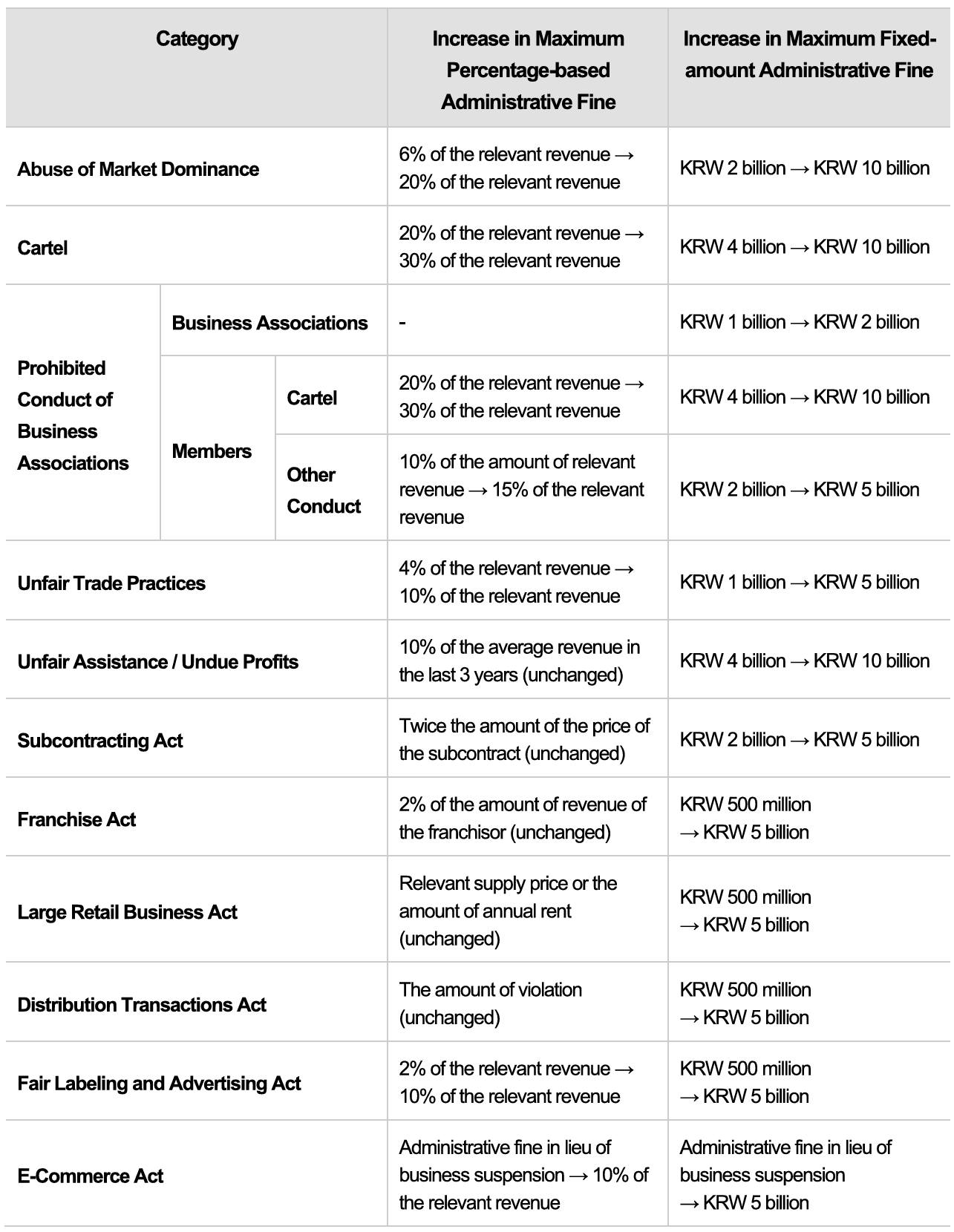
Regarding abuses of market dominance, the current criminal penalty will be abolished, but the maximum amount of administrative fine will increase from 6% of the relevant revenue to 20% of the relevant revenue.
-
Among the regulations on concentration of economic power, the current criminal penalty will be abolished, but an administrative fine of maximum 20% of the amount in violation will be newly created for:
|
–
|
Actions constituting evasions of regulations related to holding companies and conglomerate groups;
|
|
–
|
Violations of regulations that restrict the voting rights of cross-shareholders;
|
|
–
|
Violations of regulations that restrict voting rights for financial institutions, insurers, and public benefit companies; and
|
|
–
|
Violations of regulations that restrict the establishment of holding companies,
|
-
For cartels, the maximum amount of administrative fine will increase from 20% of the relevant revenue to 30% of the relevant revenue.
-
For unfair trade practices, the maximum amount of administrative fine will increase from 4% of the relevant revenue to 10% of the relevant revenue, in order to effectively sanction unfair trade practices by the leading companies in the digital industry, an area in which the KFTC has had difficulties in defining the relevant market.
-
For violations of the Fair Labeling and Advertising Act, the maximum amount of administrative fine will increase from 2% of the relevant revenue to 10% of the relevant revenue in order to penalize more strictly deceptive online advertising and false or exaggerated advertising that threatens consumer life and safety.
-
Currently, administrative fines under the Act on the Consumer Protection in Electronic Commerce (“E-Commerce Act”) can only be imposed in lieu of business suspensions. However, for solicitation of customers through false or deceptive means, the KFTC is planning to create a general rule that allows the imposition of administrative fines which will account for the severity of the violation (with the maximum amounts set to be consistent with the Fair Labeling and Advertising Act).
-
For fixed-amount administrative fines, the maximum administrative fine for “illegal assistance” under the FTL will increase from KRW 4 billion to KRW 10 billion, to reflect the nature and severity of the legal violations. Regarding violations of other laws under the KFTC’s jurisdiction, the amounts of fixed-amount administrative fines will also increase.
|
|
2.
|
Increasing Penalties for Repeat Violations
The Penalty Reform Plan will also increase the administrative fines that are imposed on repeat offenders, in order to more effectively prevent the recidivism.
Currently, the administrative fine increases by an amount between 10% and 20% if there is a single repeated violation of the law. The Penalty Reform Plan will increase the additional penalty for repeat offenses by up to 50% for a single repeated violation of the law and up to 100% for four or more repeated violation.
|
Number of repeat violations
|
Rate of increase of the administrative fines
|
|
Once or more
|
10% or more, but less than 20% → More than 40%, but 50% or less
|
|
Twice or more
|
20% or more, but less than 40% → More than 50%, but 70% or less
|
|
Three times or more
|
40% or more, but less than 60% → More than 70%, but 90% or less
|
|
Four times or more
|
60% or more, but less than 80% → More than 90%, but 100% or less
|
|
Additionally, the KFTC announced that it is planning to review the administrative fine system as a whole, including the method of imposing the fixed amount-based administrative fines (a method that is not often used in other jurisdictions) and is planning to commission a related research project in early 2026.
Because the administrative fine system may further change, for instance to replace the fixed amount-based administrative fine entirely with the percentage-based administrative fine, or to impose administrative fines based on different factors, companies should continue monitoring the relevant developments on this topic.
[Korean Version]