On June 1, 2026, the Korea Fair Trade Commission (the “KFTC”) implemented the revised Guidelines on Labeling and Advertisements Concerning Recommendations and Endorsements (the “Revised Guidelines”). The Revised Guidelines mandate clear disclosure of the use of AI-generated endorsers (i.e., virtual characters created using generative AI and deepfake technology) in marketing, and establish related disclosure methods.
In particular, AI-generated virtual persons were added as a new type of endorser subject to the Revised Guidelines, which previously provided labeling and advertising principles and examples for four types of endorsers: (i) consumers, (ii) celebrities, (iii) experts, and (iv) organizations and institutions.
The background, specific details and future outlook of the Revised Guidelines are further discussed below.
|
1.
|
Background
The increasing use of AI to create hyper-realistic “experts” (such as medical doctors or professors) in advertising has raised concerns that consumers may mistake recommendations or endorsements by these virtual characters for those of real professionals, thereby influencing their purchasing decisions. To address this risk and protect consumers’ ability to make rational choices, the KFTC proposed amending the Guidelines to require clear disclosure when recommendations or endorsements are made by AI-generated virtual humans, and to provide specific guidance on appropriate disclosure phrases and methods.
As the Guidelines are subordinate regulations (administrative rules of the KFTC) under the Fair Labeling and Advertising Act (the “FLAA”)—which establish specific criteria for the KFTC to determine potential violations—it is essential to fully understand and strictly comply with them to prevent any violations of the law.
|
|
2.
|
Details of Revised Guidelines
Under the Revised Guidelines, advertisements featuring AI-generated characters must include a clear disclosure to ensure consumers can distinguish them from real professionals. For text-based platforms such as blogs and online forums, labels such as “contains AI-generated virtual characters” or “includes a virtual character” must appear in the title or at the beginning of the post. In addition, for visual media such as photos and videos, a “virtual character” tag should be displayed near the character throughout their appearance to ensure easy identification and discernibility.
The examples of disclosure methods provided by the KFTC are as follows. Businesses should review these examples and prepare appropriate disclosure statements that align with the Revised Guidelines.
[Disclosure Method for Text-Based Platforms]
|

|
(i) Disclosure in the title or at the beginning of the body
- Title: Place the phrase “Contains virtual character(s)” at the start of the title.
- Body: Alternatively, display a statement such as “This post contains virtual characters generated using AI” in the body of the advertisement.
(ii) Disclosure in photos
- Use a font color that contrasts with the background and place the phrase “Virtual character” in close proximity to the virtual character.
|
[Disclosure Method for Visual Media]
|

|
Disclosure in video clips
- Use a font color that contrasts with the background and display the phrase “Virtual character” in close proximity to the virtual character.
|
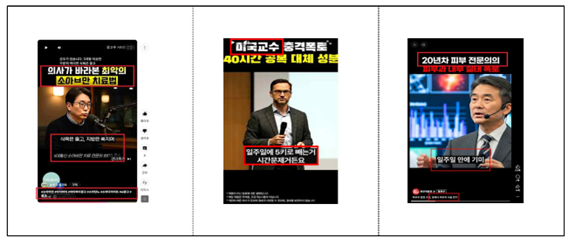
When issuing an advance notice for the proposed amendments on April 8, 2026, the KFTC also provided the following examples of unfair advertisements using AI-generated endorsers. These examples clarify that advertisements featuring AI characters who make fake recommendations—as though they were actual experts basing their claims on real experiences—may constitute unfair advertising.
[Unfair Advertising Featuring AI-Generated Experts]
|
|
|
Doctor reveals worst treatment for pediatric obesity
Loss of appetite and fat
|
US professor’s shocking revelation: ingredient with 40-hour fasting effect
Easily lose 5 kg in a week
|
20-year dermatologist exposes actual dermatology practices
Dark spots vanish in a week
|
|
* Source: The Government’s Comprehensive Plan to Eradicate AI-Generated False or Exaggerated Advertisements (Published on December 9, 2025)
-
“Pediatric obesity specialist who graduated from S University,” “US professor,” “Dermatologist with 20 years in practice”
→ These statements in advertisements featuring AI-generated experts may mislead consumers into believing that the advertised product is recommended by an actual expert.
-
“Easily lose 5 kg in a week,” “Dark spots vanish in a week”
→ These statements in advertisements featuring AI-generated doctors may mislead consumers into believing that the product’s efficacy and effects are greater than they actually are.
|
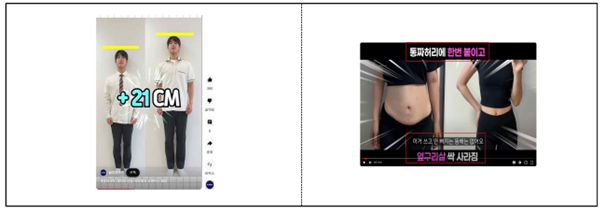
[Unfair Advertisements Featuring Before-and-After Images Distorted Using AI]
|
|
| |
Apply once and see belly fat disappear
This works for all belly types, no exceptions
|
|
* Source: The Government’s Comprehensive Plan to Eradicate AI-Generated False or Exaggerated Advertisements (Published on December 9, 2025)
|
|
|
3.
|
Outlook
In announcing the enforcement of the Revised Guidelines, the KFTC noted its expectation that these updates will help consumers make rational purchasing decisions by making it easier to identify AI-generated endorsers. Additionally, the KFTC anticipates that providing clear rules for using AI-generated endorsers will enhance predictability for advertisers and influencers, helping them avoid legal violations.
Companies planning to run advertisements featuring AI-generated endorsers should review their practices in advance and conduct a thorough assessment of the new disclosure obligations and methods specified in the Revised Guidelines to ensure compliance with the FLAA. Furthermore, because anyone can now easily create content using AI, public interest in such production activities continues to grow. Given the increasing number of companies using AI-generated endorsers to promote their products or services, as well as social media influencers producing AI content, businesses should proactively review their overall labeling and advertising practices.
Companies should also prepare for potential KFTC inspections, as the KFTC plans to conduct monitoring activities to ensure the smooth implementation of the Revised Guidelines. Because advertisements featuring virtual characters and other AI-driven promotional practices are attracting significant attention and scrutiny worldwide—including in Korea—a careful assessment of the regulatory risks is highly recommended when planning and executing advertising activities.
|
[Korean Version]