On April 8, 2026, the Korea Fair Trade Commission (“KFTC”) announced a proposed amendment (“Proposed Amendment”) to the Guidelines for Reviewing Labeling and Advertisements Containing Recommendations and Endorsements (“Guidelines”). The KFTC is accepting public comments on the Proposed Amendment from April 8, 2026 to April 28, 2026.
The Proposed Amendment targets the rising use of generative AI and deepfakes in marketing, requires disclosing the use of virtual personas (e.g., AI-generated endorsers), and establishes disclosure methods. Businesses subject to the Fair Labeling and Advertising Act (“FLAA”) are advised to review their advertising practices and materials to ensure compliance with such disclosure requirements.
|
1.
|
Background
The increasing use of AI to create hyper-realistic “experts” (such as doctors or professors) in advertising has raised concerns that consumers may mistake these virtual characters for real professionals. To address this risk and protect consumers’ ability to make rational purchasing decisions, the KFTC has proposed the Proposed Amendment to require clear disclosures for AI-generated recommendations and endorsements, and provide specific guidance on appropriate wording and method of disclosure.
As the Guidelines serve as the KFTC’s criteria for assessing potential violations of the FLAA, businesses are advised to review their advertising practice and ensure a thorough understanding of the Proposed Amendment to avoid potential violations of the FLAA.
|
|
2.
|
The Amendment
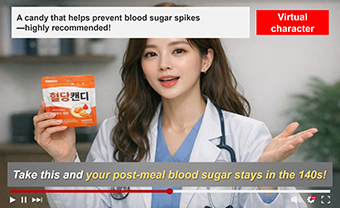
Under the Proposed Amendment, advertisements featuring AI-generated characters must include clear disclosures to ensure that consumers can distinguish them from real professionals. For text-based platforms such as blogs and online forums, labels such as “contains AI-generated virtual characters” or “includes a virtual character” need to appear in the title or at the beginning of the post. In addition, for visual media such as photos and videos, a “virtual character” tag should be displayed near the character throughout their appearance to ensure easy identification.
Therefore, businesses should review the examples provided by the KFTC and prepare appropriate disclosure wording that is in line with the Amendment.
[Disclosure Method for Text-Based Platforms]
|

|
① Disclose in the title or at the beginning of the body
- (Title) Place the phrase [Contains virtual character(s)] at the start of the title.
- (Body) Alternatively, display wording such as “This post contains virtual characters generated using AI” in the body of the advertisement.
② Disclosure in photos
- Use a color that contrasts with the background and place the expression [Virtual character] close to the virtual character.
|
[Disclosure Method for Visual Media]
|
|
Disclosure in video clips
- Use a color that contrasts with the background, and display the wording “[Virtual character]” in close proximity to the virtual character.
|
|
|
3.
|
Outlook
After reviewing feedback from stakeholders and relevant ministries during the public comment period, the KFTC will finalize and implement the Proposed Amendment after the requisite resolution process. Once it takes effect, the KFTC could monitor compliance, so companies should review their practices in advance and prepare necessary compliance measures. Because advertising that features virtual characters and other AI-driven promotional practices is attracting significant attention and scrutiny worldwide, including in Korea, we recommend careful assessment of regulatory risk when planning and executing advertising activities.
|
[Korean Version]